Rats and mice
Rodent Control in Tampa, FL
Roof rat, Norway rat, or mouse. Get this wrong and everything after it underperforms.
Call 813-692-1105Rodent control in Tampa, FL
Rodent control in Tampa, FL starts with a question that sounds basic and decides everything after it: what is actually in the building? Roof rat, Norway rat, and house mouse all get called the same thing by homeowners, and each one needs different trap placement, different spacing, and a different set of openings closed. Get the identification wrong and every step that follows underperforms.
Roof rat
Rattus rattus. The dominant rodent in Hillsborough County and the animal behind the large majority of attic calls here.
How it looks: slim bodied, large ears, pointed nose, and a tail longer than its head and body combined. Typically dark grey to black, though colour varies enough that it is not a reliable test on its own.
Droppings: around half an inch, spindle shaped, pointed at both ends.
Where it lives: attics, soffit runs, upper wall voids, and outdoors in the frond skirt of untrimmed palms and in dense canopy. It lives above you.
How it gets in: overhead. Palms and oak limbs touching the roof, fence lines, and utility drops carry it to the roofline, and it enters at soffit returns, gable and turbine vents, roof-to-wall seams, and the open batten space behind the first course of barrel tile.
What that means for the work: trap lines go high, along top plates, truss chords, and duct runs. Sealing concentrates on the roofline. And the tree line gets cut back, because the route is half the problem. Full detail on the roof rat removal page.
Norway rat
Rattus norvegicus. Present across the county, concentrated near water, waste, and disturbed ground.
How it looks: heavy bodied, blunt nose, small ears, and a tail shorter than its head and body. Noticeably thicker set than a roof rat.
Droppings: larger, up to three quarters of an inch, with blunt rounded ends.
Where it lives: burrows. Along foundation lines, under sheds and decks, in canal and ditch banks, in storm drains, and around dumpster pads.
How it gets in: at ground level. Garage door corners, weep holes, dryer vents, hose bib penetrations, and unsealed plumbing or HVAC chases. It is most likely to be your animal if you are near the Hillsborough River, the canal network through Town ‘n’ Country, or a drainage ditch.
What that means for the work: sets go low, along foundation lines and near burrow openings, and sealing concentrates on the ground line rather than the roof. Burrow locations outside are part of the job rather than incidental.
House mouse
Mus musculus. Less common than rats here but regular in older housing and multi-unit buildings.
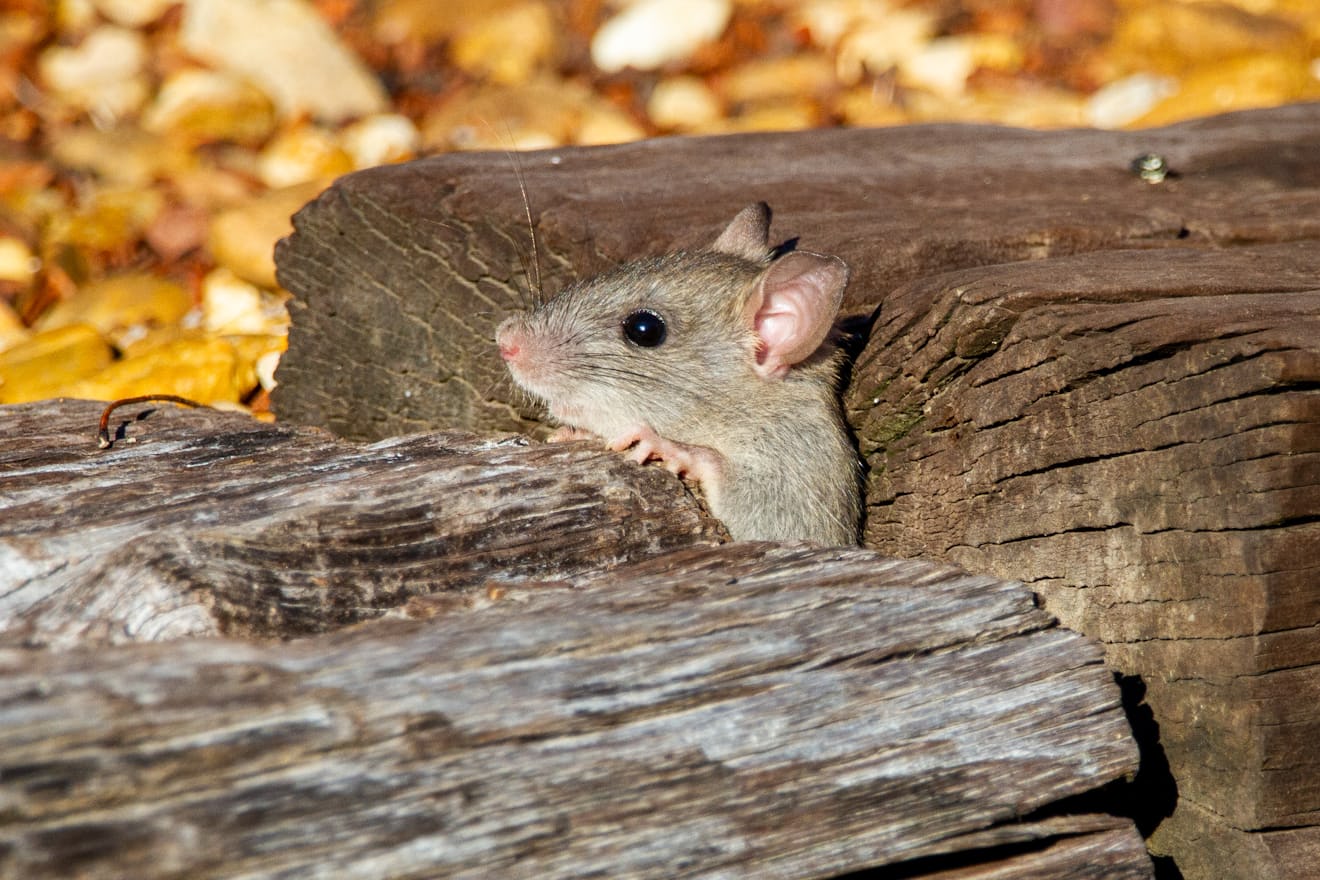
How it looks: small, under an ounce, with a thin tail roughly the length of its body and a small pointed face.
Droppings: rice-grain sized, and usually in far greater quantity than rat droppings, since mice produce a great many of them.
Where it lives: close to food. Kitchens, pantries, wall voids behind cabinetry, and inside appliance housings.
How it gets in: through a quarter-inch gap, which is roughly half what a rat needs. That makes mouse exclusion a much finer job: gaps around pipework, gaps under doors, and utility penetrations that would be irrelevant for a rat.
What that means for the work: spacing changes completely. A mouse ranges only a short distance from its nest, so sets go much closer together than a rat layout, and along walls rather than across open areas. A rat-spaced line in a mouse infestation catches very little, which is one of the more common reasons DIY attempts fail.
What it is probably not
Two animals get mistaken for rodents in Tampa attics often enough to be worth ruling out on the phone.
Squirrels are the common one. They are active in daylight, loudest at dawn and again in late afternoon, and make heavier, rolling noises rather than quick scurrying. Rats are quiet during the day and start about an hour after sunset. Timing alone usually settles it.
Larger wildlife, raccoons and opossums, produce much heavier sounds, often with vocalizations, and leave correspondingly larger droppings. That is wildlife work with different handling requirements, not rodent work, and it needs a different operator.
The method is the same, the details are not
Whichever rodent it turns out to be, the sequence holds: inspect and identify, cut the approach route, trap on the mapped runways, seal every opening with material that holds, then clean what was left behind. What changes is where the traps go, how far apart, which openings matter, and what size gap counts as an entry point.
That is the entire argument for identification first. It is not a formality, and it is why a technician who starts setting equipment before walking the exterior is working from an assumption rather than a map.
What this does not cover
Rats and mice only. No roaches, no ants, no termites, no mosquitoes, and no larger wildlife. In Tampa that is worth stating plainly, because most of the market sells a quarterly general pest route with rodents attached to it, and a route visit is not a rodent job.
If you want one company handling everything on a schedule, a full-service route genuinely is the better fit and it is a reasonable thing to want. If the problem is rats or mice and nothing else, this is the whole job rather than a line item on someone's rotation. You get the scope and the number before anything starts.
Related rat work in Tampa
Rat Removal
Clear the rats living in your attic, soffits, and wall voids with a targeted trap-and-remove plan.
The Tampa ratRoof Rat Removal
The climbing rat behind most Tampa attic noise, traced from the tree line to the hole it uses.
Heavy activityInfestation Treatment
Knock down a breeding population across the whole house, then shut the way back in.
Keep them outPrevention & Exclusion
Close the soffit returns, tile edges, and vent gaps that let rats walk straight back in.
Rodent Control questions
How do I tell a rat from a mouse?
Size and proportion. An adult rat is heavy bodied and typically well over half a pound; a house mouse weighs under an ounce and has a noticeably smaller head relative to its body. Droppings are the easier test: rat droppings run roughly half an inch or longer, mouse droppings are about the size of a grain of rice.
Are there mice in Tampa or only rats?
Both, though rats dominate. House mice turn up in kitchens, pantries, and wall voids, and they are more common in older housing and in multi-unit buildings. Mice need tighter trap spacing than rats, so a rat-spaced layout tends to under-perform on them.
Could the noise in my attic be squirrels instead?
Very possibly, and timing is the giveaway. Squirrels are active in daylight, loudest around dawn and again in late afternoon, and make heavier rolling sounds. Rats start about an hour after sunset and move in quick bursts. Getting this wrong wastes weeks, which is why identification comes before anything is set.
Do you handle squirrels, raccoons, or opossums?
No. This is rats and mice only. Larger wildlife is genuinely different work with different legal handling requirements, and it needs a wildlife operator rather than a rodent one.

Get the rats out, then keep them out.
Describe what you are hearing and where. You get the scope and the number before anything starts, with no obligation.
813-692-1105Day or night, seven days a week