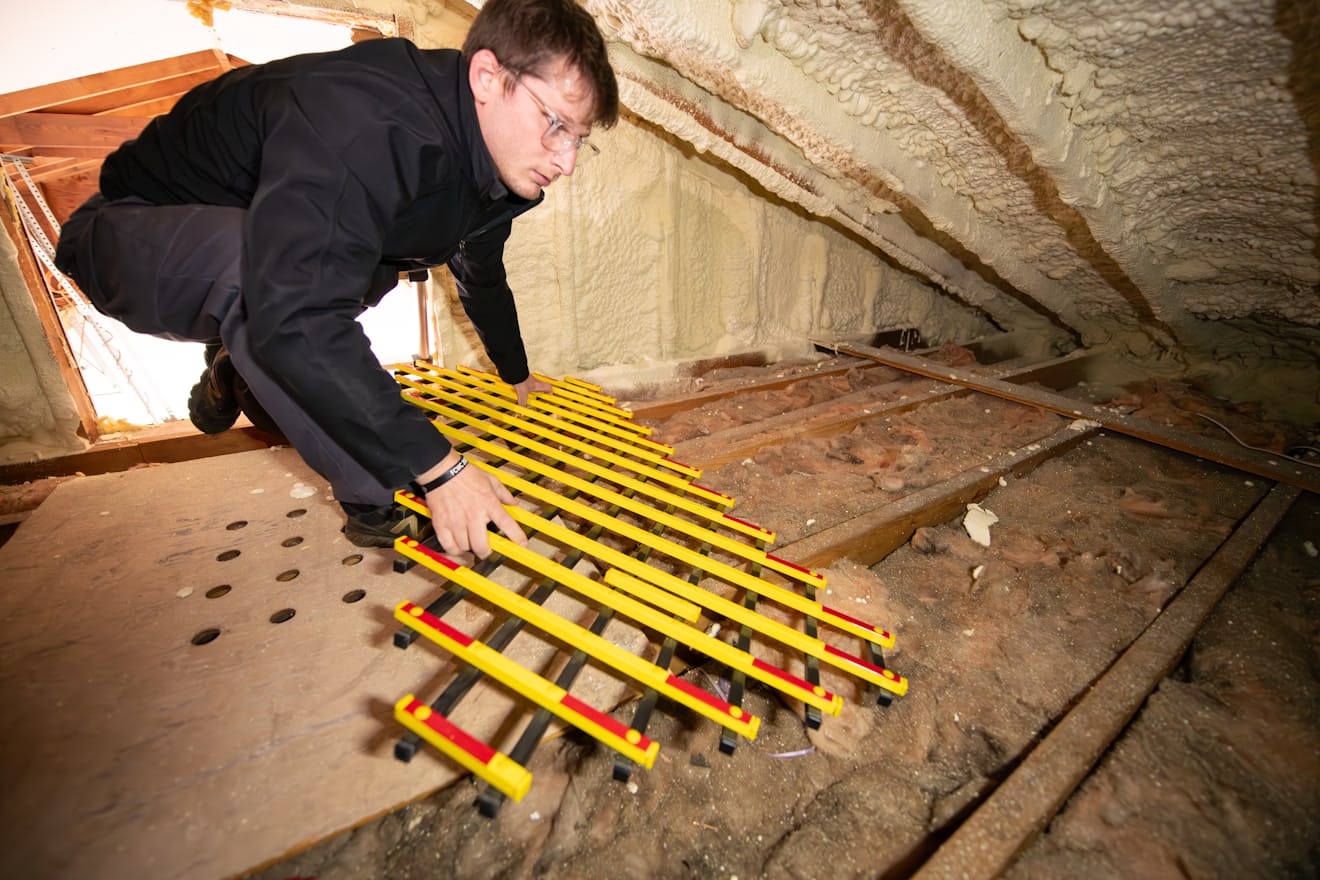
Above the ceiling
Attic Rat Control & Cleanup in Tampa, FL
Clearing the attic is a third of the job. The insulation, the ductwork, and the roofline are the rest.
Call 813-692-1105Attic rat control and cleanup in Tampa, FL
Attic rat control in Tampa, FL is the back half of a rat job, and it is the half that gets quoted least often. Clearing the animals out of an attic is roughly a third of the work. The insulation, the ductwork, and the roofline are the rest, and skipping them is why some houses get treated twice.
In Hillsborough County the attic is where nearly all of this happens, because the roof rat is the dominant species here and it lives above you. Most homes are slab or concrete block with no crawl space, so there is nowhere else for a climbing rat to establish. The attic is the whole battleground.
What a rat-occupied Tampa attic looks like
There is a fairly consistent picture once you get up there with a light:
- Runways. Dark grease lines along truss chords, the top plate, and duct runs, worn in by the same bodies passing hundreds of times.
- Droppings concentrated along those lines rather than scattered evenly, plus heavier accumulations at nesting points.
- Shredded insulation pulled into nests, usually tucked into a corner, against a chimney chase, or behind stored boxes.
- Chewed flex duct, sometimes with visible tears in the outer jacket and the insulation pulled out of it.
- Gnawed wiring, which is the damage worth finding early for obvious reasons.
- Urine staining on framing and across the insulation surface, often only obvious under a good light.
The order the work has to happen in
Cleanup goes last, and that sequencing is not negotiable. Cleaning an attic that still holds live animals means doing it twice, because the droppings and the scent trails come straight back. The order is inspect, cut the overhead route, trap until the catch stops, seal every mapped opening, then clean.
That means attic cleanup usually happens two to four weeks after the first visit rather than on day one. Anyone offering to clean the attic before the trapping is finished is selling you a service twice.
Removing what they left
Fouled insulation comes out. Insulation used as nesting material or saturated with urine holds odor, holds scent trails, and has usually lost its thermal value anyway once it has been compressed and shredded. Removal is done in a way that keeps material contained rather than stirred into the air, because dried droppings and urine become airborne easily and a Tampa attic in summer is not a place you want to be breathing dust.
Droppings get removed rather than swept about. Framing and surfaces get treated to break down the residue and the odor at the source, not covered with a fragrance that masks it for an afternoon. Where the accumulation is light and localized, targeted cleaning and treatment often does the job without pulling the whole insulation layer, and the inspection decides which case you have.
The ductwork nobody checks
This is the Tampa-specific part. Nearly every house here runs its air conditioning ducts through the attic, and rats chew flex duct: the outer jacket, the insulation wrap, and sometimes the inner liner. A damaged run dumps conditioned air into the attic, so the system runs longer to reach the same temperature and the power bill climbs quietly.
Damaged runs get flagged during cleanup with their locations noted, so repair or replacement can be handled properly. It is common for a homeowner to discover the duct damage explains a summer bill they had already written off as the weather.
Why scent is the thing that matters most
Rats communicate through urine and scent marking. A trail laid down along a runway outlives the animal that made it by a long way, and it reads to the next rat working the block as a recommendation: this route is safe, this structure is accessible, another animal did well here.
That is the real argument for cleanup, and it is stronger than the aesthetic one. An attic that was cleared of animals and sealed but never cleaned is still advertising. This is also why cleanup and exclusion belong in the same conversation: one removes the invitation, the other removes the door.
Sealing the attic behind them
Before cleanup finishes, the roofline gets closed. In Tampa that usually means soffit returns, gable and turbine vents, the seam where a carport or Florida room roof meets the main wall, and on tile roofs the batten space behind the first course where the foam bird stop has failed.
Closures use galvanized hardware cloth and sheet metal. Expanding foam does not hold: a rat chews through a foam plug in a night and leaves the opening wider. Screen mesh fails the same way. This is slow, unglamorous work and it is the part that decides whether the attic stays empty.
Attic access in Tampa homes
A practical note, because it affects scheduling and scope. Older bungalows in Seminole Heights, Tampa Heights, and Hyde Park often have tight attic access, low headroom at the eaves, and knob-and-tube era framing with open chases running down into the walls. Block homes from the 1950s through the 1970s usually have better access but very shallow eave clearance, which makes the soffit run hard to work and easy to under-inspect.
Two-story homes and houses with vaulted or tray ceilings can have attic areas that are effectively unreachable from the hatch, which sometimes means working a section from the exterior instead. None of this changes the method. It changes how long it takes and what the access plan looks like, and it is the sort of thing that gets settled during the inspection rather than discovered halfway through.
What you get at the end
An attic that is empty of animals, closed at the openings that were letting them in, cleared of fouled insulation and droppings, treated for odor and scent trails, with duct damage identified. Pricing depends on the size of the attic, how much insulation has to come out, and how much roofline needs closing, and you get the scope and the number before any of it starts.
Related rat work in Tampa
Rat Removal
Clear the rats living in your attic, soffits, and wall voids with a targeted trap-and-remove plan.
The Tampa ratRoof Rat Removal
The climbing rat behind most Tampa attic noise, traced from the tree line to the hole it uses.
Heavy activityInfestation Treatment
Knock down a breeding population across the whole house, then shut the way back in.
Keep them outPrevention & Exclusion
Close the soffit returns, tile edges, and vent gaps that let rats walk straight back in.
Attic Rat Control & Cleanup questions
Does rat-damaged attic insulation have to be replaced?
Not always all of it. Insulation that has been used as nesting material or soaked with urine gets removed, because it holds scent and no longer performs. Areas with light, scattered droppings can often be cleaned and treated in place. The inspection separates the two rather than defaulting to a full tear-out.
Why does my power bill go up when rats are in the attic?
Because Tampa homes run their air conditioning ductwork through the attic, and rats chew flex duct. A damaged run vents conditioned air into the attic space, so the system runs longer for the same result. It is common to find duct damage during cleanup that had been quietly costing money for months.
Is it safe to clean rat droppings myself?
Sweeping or vacuuming dried droppings makes particles airborne, which is exactly what health guidance tells you to avoid. The CDC recommends wetting material first and using appropriate protection rather than dry sweeping. In a hot Tampa attic with poor ventilation, that is a difficult job to do safely without the right equipment.
Should cleanup happen before or after trapping?
After. Cleaning an attic that still has live animals in it wastes the work, because the scent trails and droppings return immediately. The order is inspect, cut the route, trap, seal, then clean.

Get the rats out, then keep them out.
Describe what you are hearing and where. You get the scope and the number before anything starts, with no obligation.
813-692-1105Day or night, seven days a week